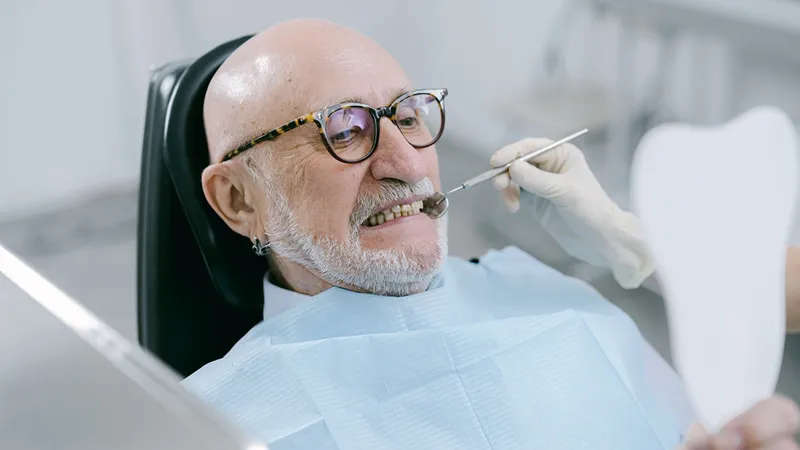
A partial denture is a removable dental prosthesis that replaces one or more missing teeth. It fits around your remaining teeth and the contours of your mouth to help restore function and fill visible spaces in your smile.
The right design depends on the number and location of missing teeth, the condition of your teeth and gums, your bite, and your preferences. A dental examination allows Dr. Scott R. Adishian to determine which tooth-replacement options may be appropriate for you.
Partial dentures can help restore chewing and speaking function, but they are not suitable for everyone. The final design should be determined after an individual evaluation.
Patients often have questions about materials, appearance, comfort, and stability. Your dentist can explain the available designs and recommend an approach based on your oral health and treatment goals.
Partial dentures can be made using different materials and designs. Depending on your needs, the construction may involve acrylic or a metal framework with replacement teeth designed to coordinate with your natural smile.
The goal is not simply to fill a space. Your partial denture should be designed to work with your bite and remaining teeth while providing an appearance that complements your smile.
A removable partial denture is one possible approach to replacing missing teeth. Depending on your oral health, preferences, and treatment goals, alternatives may include fixed restorations or implant-supported solutions.
For patients considering an implant-based alternative, implant-supported bridges may provide another way to replace multiple missing teeth. Your evaluation can help determine which options are appropriate to discuss.
Treatment begins with an examination of your teeth, gums, bite, and overall oral health. Dr. Adishian can then discuss your goals and explain available tooth-replacement options before a treatment plan is selected.
Once a partial denture is planned, the process generally involves creating records of your mouth so the prosthesis can be designed to fit your individual anatomy. Depending on the design and laboratory process, appointments may be needed for fitting, adjustments, and delivery.
Adjustment is a normal part of getting used to a removable partial denture. Eating and speaking may feel different initially, and follow-up adjustments may be appropriate if the appliance feels uncomfortable or does not fit as expected.
Dr. Scott R. Adishian has provided dental care in Arcadia and the San Gabriel Valley for more than 30 years. He earned his Doctor of Dental Surgery degree and a Specialty Certificate in Advanced Prosthodontics from the USC School of Dentistry.
He also served as a full-time Assistant Professor and part-time Clinical Assistant Professor of Restorative Dentistry at USC. His prosthodontic training and restorative dentistry experience support his approach to replacing missing teeth.
Dr. Adishian evaluates each patient's needs and discusses appropriate options for restoring function and appearance.
The cost depends on the partial denture's design, materials, number of missing teeth, and any additional treatment needed. An examination is required to determine your treatment needs and provide more specific cost information.
According to the practice's financial policy, the office is in network with Cigna, Delta Dental PPO, and Aetna. Payment options include cash, check, and credit card, with financing available through CareCredit and Sunbit. Approval and terms are determined by the financing providers.
Review the practice's financial policy for more information.
Missing several teeth can make everyday activities like eating and speaking more difficult. An evaluation can help determine whether partial dentures may be appropriate and allow you to discuss other tooth-replacement options.
Scott R. Adishian, D.D.S. Inc. is located at 600 N Santa Anita Ave, Arcadia, CA 91006, and is open Monday through Thursday from 7 AM to 5 PM and Friday from 9 AM to 1 PM. The office is closed Saturday and Sunday.
Request an appointment today to discuss partial dentures and your tooth-replacement needs.
Follow your dentist's instructions about when to wear and remove your partial denture. Your dentist can advise whether it should be removed overnight based on your oral health.
Persistent pain, pressure, or irritation may mean the partial denture needs adjustment. Contact your dental office rather than modifying the appliance yourself.
Regular dental visits allow your dentist to evaluate the fit, remaining teeth, gums, and bite. Your recommended schedule will depend on your oral health needs.
A loose partial denture may need professional evaluation or adjustment. Changes in your teeth or gums can affect how the appliance fits over time.